Prayer Music for Quiet Time: How to Pick Background Music That Helps You Pray
By Prince Oye · November 28, 2026
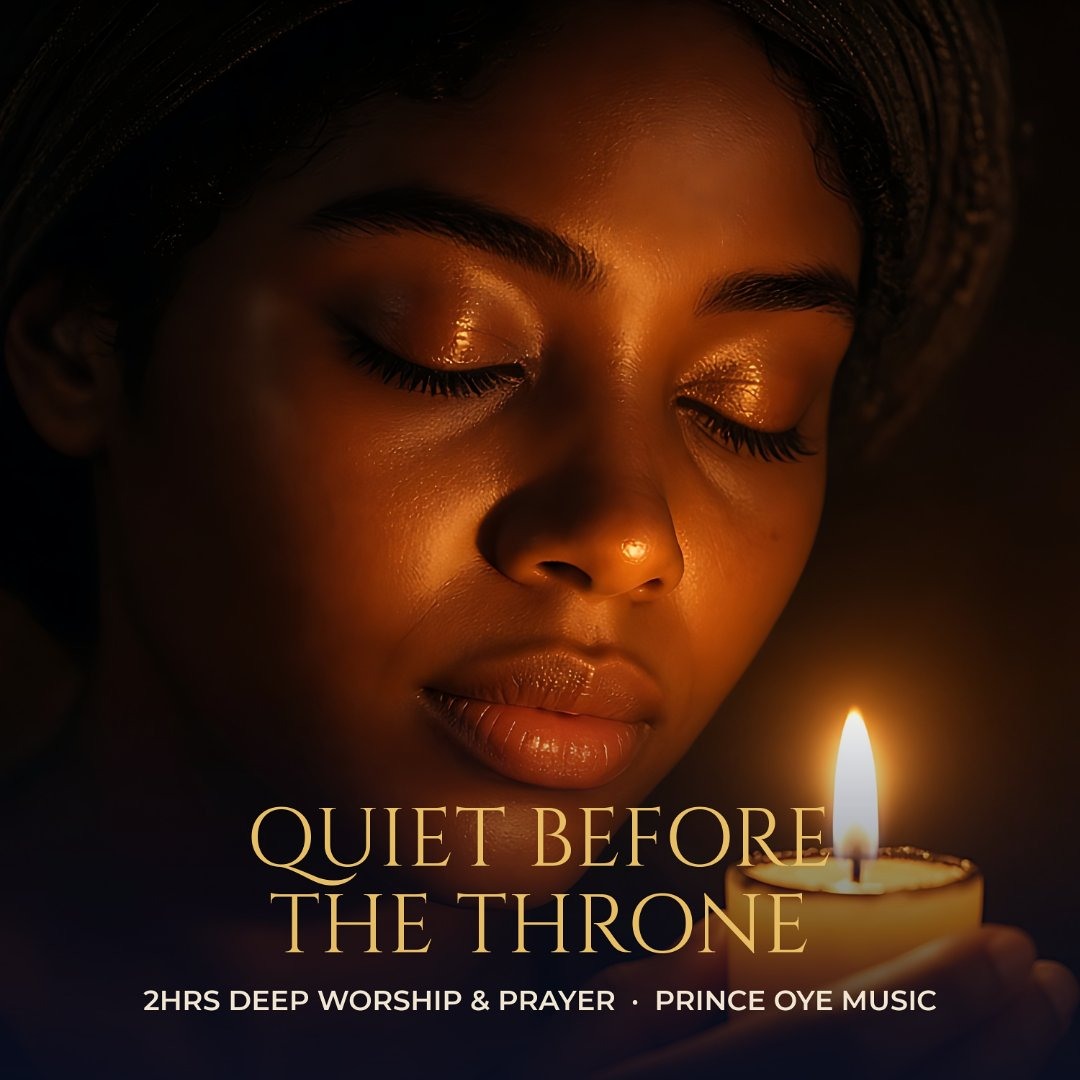
Many of us want to pray, and then we sit down and the room feels too quiet, or too loud, or our thoughts start walking away. That is one reason people look for prayer music: not a concert, and not a playlist to zone out to, but something in the background that helps the heart stay with God.
This article is a practical guide to that kind of music. We will look at what the Bible actually says about music and prayer, how to choose background worship that helps instead of distracts, a simple way to set up a quiet time, and where to start in the catalog of Prince Oye Music, including the long session Quiet Before the Throne and the song "When My Voice Is Small."
All scripture is quoted from the King James Version (KJV).
What prayer music is, and what it is not
Prayer music is worship used as a help to prayer. It might be a soft song with words, a long soaking session, or an instrumental track. The point is not the genre. The point is the direction. Good prayer music points you toward God and then makes room for you to speak, to listen, or to sit still.
It is not a substitute for prayer. If the music is playing and we never actually talk to God, we have only listened to a song. It is also not a requirement. Generations of believers have prayed in silence, on walks, and in busy kitchens with no soundtrack at all. If music helps you, use it thankfully. If it gets in the way, turn it off. Either choice can be faithful.
Jesus' own instruction about prayer is about the hidden place, not the playlist:
"But thou, when thou prayest, enter into thy closet, and when thou hast shut thy door, pray to thy Father which is in secret; and thy Father which seeth in secret shall reward thee openly."
— Matthew 6:6 (KJV)
The "secret" here is about honesty and the Father's presence, not about noise levels. Music can be part of that hidden place, as long as it does not become a performance, even a private one.
What the Bible says about music and prayer
The Bible never uses the modern phrase "prayer music," but it is full of moments in which music and prayer belong together.
Song as prayer
The Psalms are prayers that were also songs. Some were for the gathered congregation, some for the night watches, some for a single voice in trouble. When we sing a psalm, or a song built on one, we are praying with borrowed words, which is one of the best gifts worship gives us.
"Let my prayer be set forth before thee as incense; and the lifting up of my hands as the evening sacrifice."
— Psalm 141:2 (KJV)
"And the smoke of the incense, which came with the prayers of the saints, ascended up before God out of the angel's hand."
— Revelation 8:4 (KJV)
Prayer rises. Music, at its best, gives that rising a shape.
Music that settles a troubled spirit
"And it came to pass, when the evil spirit from God was upon Saul, that David took an harp, and played with his hand: so Saul was refreshed, and was well, and the evil spirit departed from him."
— 1 Samuel 16:23 (KJV)
When an evil spirit troubled Saul, David played the harp, and Saul was refreshed. The passage is not a complete theology of music, and it should not be turned into a promise that a playlist will fix every spiritual or mental struggle. It does show that God can use music to quiet a troubled person. If a gentle song helps your body and mind settle enough to pray, you are in an old stream.
Music that prepares a prophet to hear
"But now bring me a minstrel. And it came to pass, when the minstrel played, that the hand of the LORD came upon him."
— 2 Kings 3:15 (KJV)
Elisha, asked for a word from the Lord, said, "But now bring me a minstrel." As the musician played, "the hand of the LORD came upon him." Again, this is a particular moment, not a method we can demand. It is a biblical picture of music making a person ready to hear.
Music in the house of God
"Moreover David and the captains of the host separated to the service of the sons of Asaph, and of Heman, and of Jeduthun, who should prophesy with harps, with psalteries, and with cymbals: and the number of the workmen according to their service was:"
— 1 Chronicles 25:1 (KJV)
David set apart musicians "who should prophesy with harps, with psalteries, and with cymbals." In the temple dedication under Solomon, the singers and instrumentalists were together "as one, to make one sound," and the house was filled with a cloud:
"It came even to pass, as the trumpeters and singers were as one, to make one sound to be heard in praising and thanking the LORD; and when they lifted up their voice with the trumpets and cymbals and instruments of musick, and praised the LORD, saying, For he is good; for his mercy endureth for ever: that then the house was filled with a cloud, even the house of the LORD; So that the priests could not stand to minister by reason of the cloud: for the glory of the LORD had filled the house of God."
— 2 Chronicles 5:13–14 (KJV)
And the New Testament tells the church to let music carry the word of Christ among us:
"Let the word of Christ dwell in you richly in all wisdom; teaching and admonishing one another in psalms and hymns and spiritual songs, singing with grace in your hearts to the Lord."
— Colossians 3:16 (KJV)
"Speaking to yourselves in psalms and hymns and spiritual songs, singing and making melody in your heart to the Lord;"
— Ephesians 5:19 (KJV)
"Making melody in your heart to the Lord" is a good motto for prayer music. The audience is God. The aim is a heart that is actually turned toward Him.
When words are few
"Likewise the Spirit also helpeth our infirmities: for we know not what we should pray for as we ought: but the Spirit itself maketh intercession for us with groanings which cannot be uttered."
— Romans 8:26 (KJV)
"Be still, and know that I am God: I will be exalted among the heathen, I will be exalted in the earth."
— Psalm 46:10 (KJV)
Some days the right "prayer music" is almost no music at all, only enough sound to help you "be still." Other days, a long song gives the Spirit's groanings a little room. You can change what you use as the day changes.
How to pick background music that helps you pray
Here is a simple set of tests. They are not laws. They are ways of noticing whether the music is serving the prayer or competing with it.
1. Can you still hear yourself think toward God? If the track is so busy, so lyrically dense, or so loud that you cannot form a sentence of prayer, it is not background music. Turn it down, or choose something simpler. 2. Do the words agree with scripture? You do not need a theology exam before you press play, but the lyrics should be true. If a song makes promises God does not make, or centers the singer more than the Lord, pick another. 3. Is the pace kind to prayer? Most people pray better with slower music than with a praise break, though there is a time for both. A mid-tempo or unhurried song leaves space between the lines. 4. Lyrics or instrumental? Lyrics help when you need words. Instrumental or very repetitive choruses help when you already have something to say and you do not want someone else's sentences overlapping yours. Many people use a short lyric song to begin, then a longer, quieter session to continue. 5. How long does it last? A two-minute track that ends in silence, or worse, in an auto-played song of a different mood, will yank you out of prayer. A longer session, or a playlist you have already chosen, is kinder. A timer on your phone, with the screen turned face down, can hold the time without inviting you to check messages. 6. Are there ads, pings, or sudden jumps in volume? These are small things, and they matter. Download or use an ad-free source if you can. Turn off notifications. Start at a low volume and leave it there. 7. Does it fade so you can finish? The best prayer music is willing to be forgotten. If you reach the end of a time of prayer and realize you have not thought about the song in ten minutes, that is a success, not a failure.
A short word about "instrumental prayer music," which people often search for. Instrumental tracks can be a gift, especially if sung words distract you. They can also become mere atmosphere, like pleasant noise. The test is the same: does this help me actually pray?
A simple quiet-time setup (about twenty minutes)
You can do this at a table, in a parked car, or in a chair before the house wakes up.
1. Prepare the space (1 minute). Put the phone on do not disturb, or in another room with a speaker. Pour a glass of water. Sit down. 2. Arrive (2 minutes). Play a short, slow song, or no song at all. Say, "Father, I am here." Do not rush to the list. 3. Read (5 minutes). Open a short passage. A psalm, a Gospel paragraph, or a verse you are learning is enough. Read it twice, once aloud. 4. Pray (8 to 10 minutes). Let a longer session play at low volume if it helps. Pray in a simple shape: thanks, confession, asking for others, asking for yourself. If words run out, sit still. "Be still, and know that I am God" is a complete prayer. 5. Close (2 minutes). Turn the music down or off. Thank God for the time. Write one sentence if you can, so the hour does not vanish as soon as the day begins.
If you want a morning version of this, see Morning Worship Songs and a 10-Minute Morning Prayer Routine. If you want help using longer, repetitive sessions, see What Is Soaking Worship? and Deep Worship Songs for Prayer.
Common obstacles, and some gentle fixes
- "I just listen and never pray." Start the music after you have already said one sentence to God. Let the song support a prayer that has already begun.
- "The lyrics fight with my Bible reading." Switch to a softer instrumental, or to a wordless chorus, while you read. Bring the lyric songs back when you pray.
- "I fall asleep." That may be your body telling you it needs rest, especially at night, and God is not offended. If you meant to be awake, sit at a table, pray at an earlier hour, or use a slightly more alert song.
- "I get restless." Try a shorter time, not a longer one. Ten honest minutes are better than a half hour of guilt. A short walk with a single song can also be prayer.
- "I feel nothing." Feelings are not the measure. Jesus' teaching in Matthew 6 is about the Father who sees in secret, not about the temperature of our emotions.
Prayer music from Prince Oye Music
Prince Oye Music has a large catalog of soaking, sleep, and deep worship sessions written for prayer and quiet time. The descriptions below follow the song and album pages, and the video titles.
A whole room of quiet: *Quiet Before the Throne*
Quiet Before the Throne: 2hrs Deep Worship & Prayer is a 34-song album released October 31, 2026. Its page describes the songs as original soaking worship for prayer, devotion and quiet time with God. It is one of the best places in the catalog to begin a longer quiet time, because you will not be interrupted by a sudden change in style. Songs that many people start with include Quiet Before the Throne, Here in the Secret Place, Still Waters and Faithful Through It All.
For a similar long session on video, this one runs just under two hours:
The album Lay My Head Down Here is the companion set.
When the words will not come
- When My Voice Is Small is described on its page as a song "for the days when prayer is quiet and words are hard to find." It is part of the Deep Worship Sessions, released October 28, 2026. If you have ever sat down to pray and felt that you had nothing to say, start here.
Other sessions that work as background prayer music
- Grace Upon Grace | 2hrs Deep Worship & Prayer is a session that runs 1 hour and 59 minutes, made for staying with a theme in prayer. The song Grace Upon Grace Lord sits in the same family. You can read more in Worship Songs About Grace.
If your quiet time is at the end of the day, Christian Sleep Music With Scripture will give you a softer landing. For coming to God when you feel unworthy of the time, Hebrews 4:16 Explained is a good companion.
Frequently asked questions
What is the best prayer music?
The best prayer music is the music that helps you actually pray. For many people that means a slow worship song, a long soaking session, or a simple instrumental track with no ads and no sudden changes.
Is it all right to play music while I pray?
Yes, if it helps you attend to God and does not become a substitute for prayer. The Bible joins music and prayer in the Psalms, in the temple, and in the life of the church. Silence is also a gift. You are free to use either.
Should I use lyrics or instrumental tracks?
Use lyrics when you need words, and instrumental or very repetitive songs when you already have something to say. Many people use both in the same quiet time.
How loud should prayer music be?
Low enough that your own prayer remains the main sound in the room. If you cannot hear yourself think toward God, it is too loud.
How long should a quiet time be?
Consistency matters more than length. Ten to twenty minutes is a good starting place. A longer session can be a gift on days when you have the room for it.
A closing prayer
Father, You see in secret, and You know the words we have and the words we do not have. Thank You for the gift of song, and for the stillness that sometimes comes after it. Teach us to pray, with music or without it, and to be still and know that You are God. When our voice is small, hear us. When our mind wanders, bring us back. We come to You, and that is enough to begin. Amen.
The Lord be with your quiet time. If you would like to keep worshipping, explore more videos from Prince Oye Music.