What Is Soaking Worship? A Simple Guide to Resting in God's Presence
By Prince Oye · November 28, 2026
If you search for worship music on YouTube or Spotify, you will soon see the word "soaking." Soaking worship, soaking prayer, soaking music for sleep. It sounds a little like laundry, so it is fair to ask what it actually means. Is it a style of music? A kind of prayer? Something new, or something old with a new name? And does it fit with what the Bible teaches about worship?
This guide answers those questions plainly. We will look at what soaking worship is, where the term came from, the scriptures that speak to its heart (being still before God and resting in His love), and some careful cautions. Then we will walk through a simple way to try it at home, using real worship music. All Bible verses are quoted from the King James Version (KJV).
What is soaking worship?
In everyday use, soaking worship means unhurried, quiet worship music used as the background to resting in God's presence. Soaking prayer is the practice that goes with it: you sit or lie down, quiet your mind, and simply remain with the Lord, without a list of requests and without a performance. The music is slow, repetitive and gentle on purpose. It is not meant to impress. It is meant to help you stay.
Premier Christianity describes soaking prayer as a modern form of contemplative prayer in which people put themselves in an attitude of stillness, focused on Jesus and open to the Holy Spirit, but with no requests or agenda. The aim is simply to be still in God's presence, to "waste time with Jesus."
That last phrase is worth a pause. Most of us treat time with God as a task: read a chapter, pray through a list, check the box. Soaking flips the pattern. It asks, "What if I came just to be with Him?"
Where did the term come from?
The word "soaking" has a recent history, and it is good to be honest about it.
Scholars who have studied the practice trace it to the Pentecostal and charismatic streams of Christianity in the late twentieth century. A scholarly study of soaking prayer, written by Michael Wilkinson of Trinity Western University and published in the journal Pneuma in 2014, explains that the practice is an adaptation of earlier charismatic prayer. The Roman Catholic Francis MacNutt linked "resting prayer" with healing and, according to a published history of the Toronto revival, borrowed the word "soaking" from a fellow charismatic, Tommy Tyson, to describe prolonged prayer in which the one praying would "soak" a person in healing love.
The term became widely known after the revival meetings that began in January 1994 at the church then called the Toronto Airport Vineyard, led by John and Carol Arnott. According to Wilkinson, people at those meetings would often lie on the floor in prayer, which was playfully called "carpet time." Out of that came a deliberate practice of resting in the Father's love, and the church, now called Catch the Fire, still teaches it.
Others in the church note that the same idea has older names. In earlier revivals, believers described the practice as "waiting on the Lord" or "tarrying." And across the centuries, Christians in many traditions have practiced forms of quiet, contemplative prayer. So "soaking" is a modern word, but the instinct behind it is as old as the Psalms.
The scriptures behind resting in His presence
You will not find the word "soaking" in the Bible. What you will find is a steady call to stillness, waiting and abiding. Here are the passages that speak most directly to the practice.
Be still, and know
"Be still, and know that I am God: I will be exalted among the heathen, I will be exalted in the earth."
— Psalm 46:10 (KJV)
The setting of this verse is turmoil: nations raging, mountains moved. In the middle of it, God says "Be still." Stillness is not escape from trouble. It is where we remember who is in charge.
One thing I have desired
"One thing have I desired of the LORD, that will I seek after; that I may dwell in the house of the LORD all the days of my life, to behold the beauty of the LORD, and to enquire in his temple."
— Psalm 27:4 (KJV)
David had many things to ask for: protection, victory, provision. But he says his great desire is one thing, to dwell with the Lord and behold His beauty. That is the heart of soaking: wanting God Himself more than what He gives.
A weaned child
"Surely I have behaved and quieted myself, as a child that is weaned of his mother: my soul is even as a weaned child."
— Psalm 131:2 (KJV)
A weaned child has stopped crying for milk. He sits quietly with his mother because he trusts her, not because he wants something. This is a lovely picture of resting with God without demands.
Mary at the feet of Jesus
"Now it came to pass, as they went, that he entered into a certain village: and a certain woman named Martha received him into her house. And she had a sister called Mary, which also sat at Jesus' feet, and heard his word. But Martha was cumbered about much serving, and came to him, and said, Lord, dost thou not care that my sister hath left me to serve alone? bid her therefore that she help me. And Jesus answered and said unto her, Martha, Martha, thou art careful and troubled about many things: But one thing is needful: and Mary hath chosen that good part, which shall not be taken away from her."
— Luke 10:38–42 (KJV)
Jesus does not scold Martha for caring about hospitality. He does lovingly point out that she is "careful and troubled about many things," while "one thing is needful." Mary chose to sit. If you are a Martha by temperament, as many of us are, soaking time is a way of sitting where Mary sat.
Come apart and rest
"And he said unto them, Come ye yourselves apart into a desert place, and rest a while: for there were many coming and going, and they had no leisure so much as to eat."
— Mark 6:31 (KJV)
Jesus said this to the disciples after a busy season of ministry. Rest was His idea. He offered it to people who were doing good work and were tired from it.
In quietness and confidence
"For thus saith the Lord GOD, the Holy One of Israel; In returning and rest shall ye be saved; in quietness and in confidence shall be your strength: and ye would not."
— Isaiah 30:15 (KJV)
The sad end of this verse, "and ye would not," shows how much we resist rest. God offers strength through quietness and confidence, and we often choose busyness instead.
The still small voice
"And he said, Go forth, and stand upon the mount before the LORD. And, behold, the LORD passed by, and a great and strong wind rent the mountains, and brake in pieces the rocks before the LORD; but the LORD was not in the wind: and after the wind an earthquake; but the LORD was not in the earthquake: And after the earthquake a fire; but the LORD was not in the fire: and after the fire a still small voice."
— 1 Kings 19:11–12 (KJV)
Elijah needed to hear God, and God did not come in the dramatic things but in a still small voice. If we only look for God in what is loud, we may miss Him in the quiet.
Abiding in love
"Abide in me, and I in you. As the branch cannot bear fruit of itself, except it abide in the vine; no more can ye, except ye abide in me."
— John 15:4 (KJV)
"As the Father hath loved me, so have I loved you: continue ye in my love."
— John 15:9 (KJV)
To abide means to remain. Fruit comes from staying connected, not from striving. The invitation to "continue in my love" is the very center of what people mean by soaking.
The Lord who sings over you
"The LORD thy God in the midst of thee is mighty; he will save, he will rejoice over thee with joy; he will rest in his love, he will joy over thee with singing."
— Zephaniah 3:17 (KJV)
This is a beautiful verse for anyone who thinks God is distant or disappointed. The Lord is "in the midst" of His people, mighty, and rejoicing over them with singing.
What happens during a soaking time?
For most people, honestly, not much "happens" in a visible way, and that is fine. A typical soaking time looks like this: you sit or lie quietly, music plays softly, your thoughts slow down, you become aware of the Lord's nearness, and you may pray a short, simple phrase or say nothing at all. Practitioners commonly describe a sense of peace, of being loved, or of release from tension. Some find themselves praying for a relationship or a worry that suddenly comes to mind. Others simply fall asleep, and that is also an act of trust, as Psalm 127:2 reminds us that God gives His beloved sleep.
A few cautions
Because soaking is a modern term, a few cautions are wise and keep the practice healthy.
- Test everything by scripture. Whatever you experience, the Bible is the measure. The Berean believers were commended for examining the scriptures daily (Acts 17:11). Soaking is a way to be still before the Lord. It is not a replacement for reading His word.
- Do not chase feelings or physical manifestations. Some soaking communities emphasize dramatic experiences. Those are not required, and their absence is not a sign of failure. The promise is the Lord's presence, which is by faith (Ephesians 3:17).
- Do not use it to avoid obedience or community. Resting in God's love should lead us toward loving others. Even the teachers who promote soaking say its purpose is to fill us with love so that we can give it away.
- Keep seeking care when you need it. Quiet worship can be a comfort in anxiety, grief or illness, but it does not replace a doctor or a counselor.
Christians from different traditions will emphasize different things, and that is okay. The shared center is simple: coming close to Jesus.
How to try soaking worship at home
You do not need special equipment, a church program or a certain posture. Here is a simple fifteen-minute pattern.
1. Choose your place and time. A quiet corner, a couch, a bed, even a parked car on a lunch break. Silence your notifications. 2. Play slow, simple worship. Pick music without a lot of lyrics changing every few seconds, or a long single session so you do not have to keep choosing songs. 3. Start with a verse. Read Psalm 46:10 or Psalm 131 slowly, once or twice. 4. Say a short invitation. For example: "Lord, I am here. I am not asking for anything right now. I just want to be with You." 5. Breathe and be still. When your mind drifts, as it will, gently return. You can repeat one phrase, such as "You are with me," quietly in your heart. 6. Stay. Aim for at least ten minutes. If a worry arrives, hand it over in one sentence and return to resting. 7. Close with thanks. Thank Him for His presence, and note anything He stirred in you, perhaps in a journal.
It is perfectly fine if the first few attempts feel awkward. Like any relationship, this one grows with time.
Soaking worship from Prince Oye Music
Prince Oye Music has several albums and long sessions made for this kind of quiet time. Here are a few places to begin.
Albums and songs
- Quiet Before the Throne is a 34-song collection released October 31, 2026. Its page describes the songs as original soaking worship for prayer, devotion and quiet time with God. Good tracks to begin with are Here in the Secret Place, Still Waters, Abide in Me and Sweet Holy Spirit Rest.
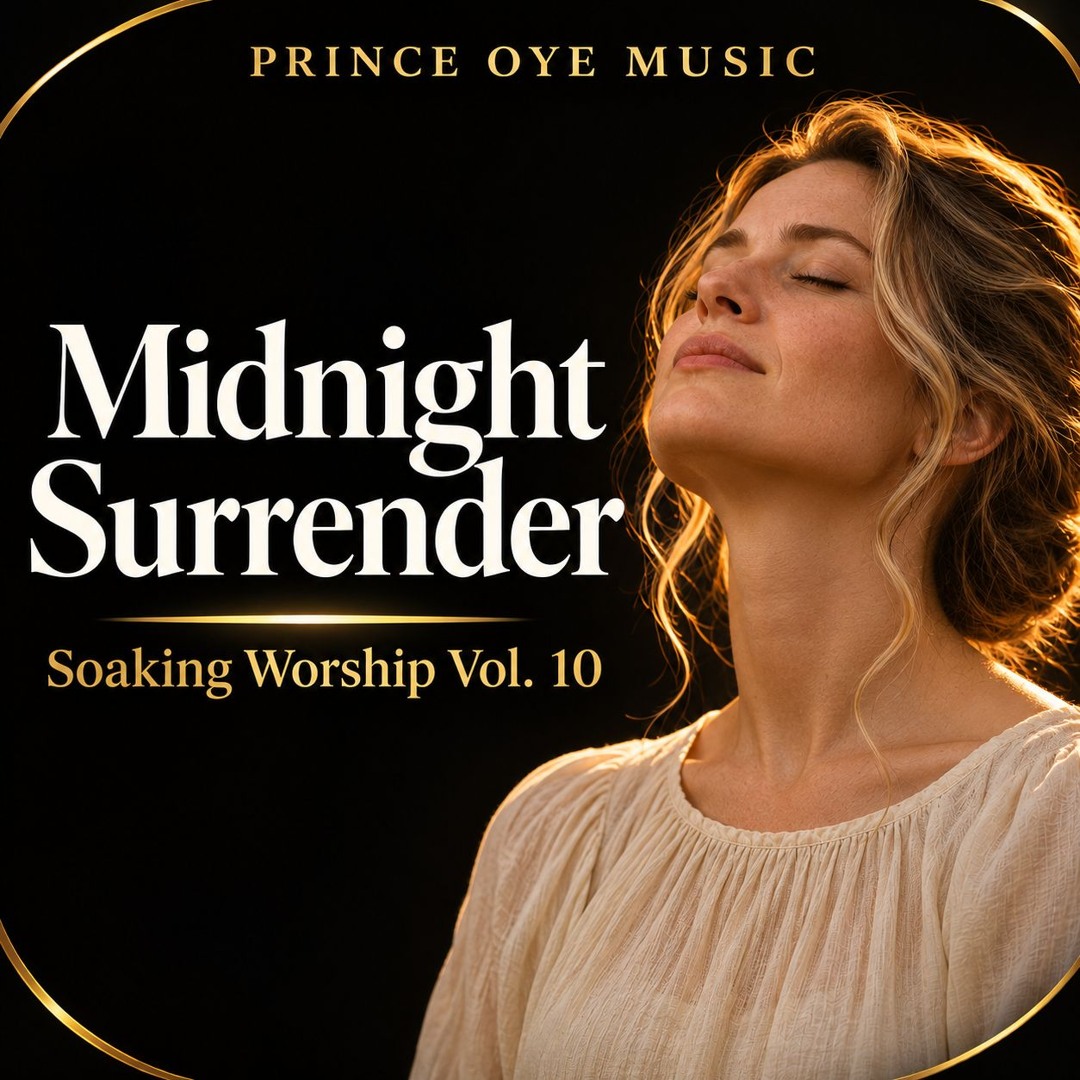
- Midnight Surrender: Soaking Worship Vol 10 has 35 songs, released November 6, 2026, made for night prayer and quiet devotion.
- Here in the Presence is a slow worship ballad about walking in with heaviness and finding rest at His feet.
- Used To This is a slow worship song about getting used to walking close with God and to what His presence does. It treats His presence as a home rather than a visit.
- Hidden In You is a gentle worship song about finding safety, rest and peace under God's covering, and its page recommends it for morning devotion, prayer time and soaking worship.
Long sessions to play while you rest
This first session is a little under two hours, which makes it easy to press play and stay put.
And this one runs just under two hours as well, with a title that says it all.
If you are curious about using music with scripture in your evening routine, our guide to Bible Verses for Sleep and Anxiety includes twelve verses and a bedtime pattern, and our article on Worship Songs for Anxiety covers what to do with a fearful heart.
Frequently asked questions
Is soaking worship biblical?
The word "soaking" is not in the Bible, but the practices it describes, being still before God, waiting on Him, sitting at Jesus' feet and abiding in His love, are all found in scripture (Psalm 46:10, Psalm 131, Luke 10:39, John 15:4). As with any practice, test it by scripture and keep it centered on Jesus.
Is soaking the same as meditation?
Christian soaking is not emptying the mind into nothing. It is focusing on the Lord, often with a verse or a simple phrase, and being open to His Spirit. The Bible speaks of meditating on God's word, and soaking is a gentle way of staying with Him.
Do I have to lie down?
No. People sit, kneel, recline or lie down. What matters is a quiet heart, not a posture.
How long should a soaking session last?
Start with ten to fifteen minutes. Many people enjoy a longer time on weekends, or a full two-hour session of worship, especially in the evening.
Can I soak while I sleep?
Many believers play quiet worship while they fall asleep, as a way to end the day with God. That is a good practice. Remember, though, that the Lord also welcomes your awake attention.
A closing prayer
Lord Jesus, I come to You not because I have something to ask, but because I want to be with You. Quiet my restless mind. Teach me to sit like Mary and to rest like a child with its mother. Let me abide in Your love, and let that love overflow to others. Thank You that You are mighty in my midst, and that You rejoice over me with singing. Amen.
Rest well in His presence. If you would like to keep worshipping, explore more videos from Prince Oye Music, or learn how music can shape your prayer life in Deep Worship Songs for Prayer.