Psalm 91 Explained: Protection, Refuge and Rest Under His Wings
By Prince Oye · November 28, 2026
Few chapters of the Bible are loved as much as Psalm 91. It is read at hospital bedsides and on restless nights, memorized by children and recited by adults in frightening seasons. Its pictures are vivid: a secret place, a shadow, a fortress, wings, angels, a lion and a serpent trampled underfoot. And its promises are bold: no terror by night, no plague near the dwelling, deliverance, honor, and long life.
Because it is so bold, Psalm 91 also raises honest questions. What does it really promise? What about believers who do face sickness and danger? Why did the devil quote it to Jesus? In this article we will read the psalm section by section in the King James Version (KJV), look at the four names of God in its opening lines, trace the image of "under his wings" through the rest of scripture, and then draw out what Psalm 91 means for us today. At the end you will find ways to pray the psalm and some worship from Prince Oye Music made for rest and shelter.
Psalm 91 in full (KJV)
Here is the whole psalm. Read it slowly, perhaps aloud.
"He that dwelleth in the secret place of the most High shall abide under the shadow of the Almighty.
I will say of the LORD, He is my refuge and my fortress: my God; in him will I trust.
Surely he shall deliver thee from the snare of the fowler, and from the noisome pestilence.
He shall cover thee with his feathers, and under his wings shalt thou trust: his truth shall be thy shield and buckler.
Thou shalt not be afraid for the terror by night; nor for the arrow that flieth by day;
Nor for the pestilence that walketh in darkness; nor for the destruction that wasteth at noonday.
A thousand shall fall at thy side, and ten thousand at thy right hand; but it shall not come nigh thee.
Only with thine eyes shalt thou behold and see the reward of the wicked.
Because thou hast made the LORD, which is my refuge, even the most High, thy habitation;
There shall no evil befall thee, neither shall any plague come nigh thy dwelling.
For he shall give his angels charge over thee, to keep thee in all thy ways.
They shall bear thee up in their hands, lest thou dash thy foot against a stone.
Thou shalt tread upon the lion and adder: the young lion and the dragon shalt thou trample under feet.
Because he hath set his love upon me, therefore will I deliver him: I will set him on high, because he hath known my name.
He shall call upon me, and I will answer him: I will be with him in trouble; I will deliver him, and honour him.
With long life will I satisfy him, and shew him my salvation."
— Psalm 91:1–16 (KJV)
The shape of the psalm
Psalm 91 has a clear movement, and seeing it helps us read it well.
- Verses 1–2: a confession. One person declares, "I will say of the LORD, He is my refuge and my fortress."
- Verses 3–13: promises of protection. The psalm turns to "thee," as if a teacher or priest is speaking to the one who trusts God, listing dangers and the shelter against each.
- Verses 14–16: God Himself speaks. The final three verses are in the first person, in God's own voice: "I will deliver him... I will answer him... I will be with him."
The KJV does not print a title or author's name over this psalm, so we will not guess at one. What we can say is that it reads like a song of trust that moves from personal faith to a promise spoken by God Himself. And at the heart of it all is not us but Him: "I will be with him in trouble."
Verses 1–2: the secret place and four names for God
"He that dwelleth in the secret place of the most High shall abide under the shadow of the Almighty. I will say of the LORD, He is my refuge and my fortress: my God; in him will I trust."
— Psalm 91:1–2 (KJV)
Four names, one God
These two verses use four different Hebrew names or titles for God, and each says something about Him. The Working Preacher commentary from Luther Seminary lists them as "Most High (Elyon)," "Almighty (Shaddai)," "LORD (Yahweh)," and "God (Elohim)."
- Most High (Elyon) speaks of God as exalted above everything, the One who is over all.
- Almighty (Shaddai) is a title with rich nuance. It is usually translated "Almighty" and associated with strength and provision. The BYU Religious Educator notes that scholars have long debated its exact origin, but it is used 48 times in the Old Testament, and Psalm 91:1 is one of them.
- LORD (Yahweh) is God's personal, covenant name, the name He gave Moses at the burning bush.
- God (Elohim) is the general word for God, in a plural form but used with a singular verb, a sign of His fullness and majesty.
So the psalm begins by piling up names: this is the God who is above all, strong to provide, faithful to His people, and fully God. Everything promised afterward rests on who He is.
What is the "secret place"?
The word translated "secret place" is rendered "shelter" in many modern translations, and it points to a hiding place, a place of cover. Some commentators connect it to the temple, the place of God's presence. Jesus uses the same idea when He tells us to pray "to thy Father which is in secret" (Matthew 6:6). In a Christian reading, the secret place is the nearness of God Himself, which believers can enter by prayer anywhere.
Notice the verbs: the one who dwells will abide. The psalm is not describing a quick visit to God in an emergency. It describes a settled life in His presence. That connects it to the verse that comes just before it in the Bible. Psalm 90:1 says, "LORD, thou hast been our dwelling place in all generations," and Psalm 91:9 repeats the idea: "Because thou hast made the LORD... thy habitation." Home, dwelling and habitation are the words of someone who lives with God.
Verses 3–8: deliverance and fearlessness
"Surely he shall deliver thee from the snare of the fowler, and from the noisome pestilence. He shall cover thee with his feathers, and under his wings shalt thou trust: his truth shall be thy shield and buckler. Thou shalt not be afraid for the terror by night; nor for the arrow that flieth by day; Nor for the pestilence that walketh in darkness; nor for the destruction that wasteth at noonday."
— Psalm 91:3–6 (KJV)
The dangers named here are the ones people have always feared: a trapper's snare (hidden danger), illness (pestilence), attack by night and by day. The psalm covers the whole twenty-four hours: terror by night, arrow by day, pestilence in the dark, destruction at noon. No hour is outside God's care.
"Under his wings"
The most tender image in the psalm is verse 4: "He shall cover thee with his feathers, and under his wings shalt thou trust." It pictures a mother bird sheltering her young. That picture appears in several places in scripture, and tracing it deepens the psalm.
"The LORD recompense thy work, and a full reward be given thee of the LORD God of Israel, under whose wings thou art come to trust."
— Ruth 2:12 (KJV)
Boaz speaks these words to Ruth, a foreign widow who had come to Israel to take refuge in Israel's God.
"Keep me as the apple of the eye, hide me under the shadow of thy wings,"
— Psalm 17:8 (KJV)
"How excellent is thy lovingkindness, O God! therefore the children of men put their trust under the shadow of thy wings."
— Psalm 36:7 (KJV)
"Be merciful unto me, O God, be merciful unto me: for my soul trusteth in thee: yea, in the shadow of thy wings will I make my refuge, until these calamities be overpast."
— Psalm 57:1 (KJV)
David prays this one while hiding from his enemies, and he says he will stay under God's wings "until these calamities be overpast." Shelter does not always mean the trouble disappears right away. It means we are held while it passes.
The image reaches its fullest picture in the Gospels. Jesus looks over Jerusalem and says:
"O Jerusalem, Jerusalem, thou that killest the prophets, and stonest them which are sent unto thee, how often would I have gathered thy children together, even as a hen gathereth her chickens under her wings, and ye would not!"
— Matthew 23:37 (KJV)
Here the invitation is personal. Jesus Himself is the One who longs to gather us under His wings, and the sorrow in His voice is that some "would not."
There is a second wing image in the Old Testament as well: God as an eagle carrying His young.
"Ye have seen what I did unto the Egyptians, and how I bare you on eagles' wings, and brought you unto myself."
— Exodus 19:4 (KJV)
"As an eagle stirreth up her nest, fluttereth over her young, spreadeth abroad her wings, taketh them, beareth them on her wings:"
— Deuteronomy 32:11 (KJV)
Together the pictures describe a God who shelters us and a God who carries us.
"A thousand shall fall at thy side"
"A thousand shall fall at thy side, and ten thousand at thy right hand; but it shall not come nigh thee. Only with thine eyes shalt thou behold and see the reward of the wicked."
— Psalm 91:7–8 (KJV)
This is one of the boldest statements in the psalm. Read as a poem, it tells us that the one who trusts God can walk fearlessly through places of great danger, because God's protection is stronger than the danger. We will come back to how to read this honestly in a moment.
Verses 9–13: the angels and the trampled lion
"Because thou hast made the LORD, which is my refuge, even the most High, thy habitation; There shall no evil befall thee, neither shall any plague come nigh thy dwelling. For he shall give his angels charge over thee, to keep thee in all thy ways. They shall bear thee up in their hands, lest thou dash thy foot against a stone. Thou shalt tread upon the lion and adder: the young lion and the dragon shalt thou trample under feet."
— Psalm 91:9–13 (KJV)
The reason for the protection is repeated: "Because thou hast made the LORD... thy habitation." Safety here is tied to dwelling with God.
The angels are described as guardians sent to serve. The New Testament speaks of them in similar terms:
"Are they not all ministering spirits, sent forth to minister for them who shall be heirs of salvation?"
— Hebrews 1:14 (KJV)
"The angel of the LORD encampeth round about them that fear him, and delivereth them."
— Psalm 34:7 (KJV)
The lion, the adder and the dragon stand for fierce and hidden powers. The psalm says they will be trampled underfoot by the one who dwells in God's shelter.
When the devil quoted Psalm 91
This is where honesty matters. Psalm 91:11–12 is the very passage the devil quoted when he tempted Jesus in the wilderness:
"Then the devil taketh him up into the holy city, and setteth him on a pinnacle of the temple, And saith unto him, If thou be the Son of God, cast thyself down: for it is written, He shall give his angels charge concerning thee: and in their hands they shall bear thee up, lest at any time thou dash thy foot against a stone. Jesus said unto him, It is written again, Thou shalt not tempt the Lord thy God."
— Matthew 4:5–7 (KJV)
Luke records the same event:
"And he brought him to Jerusalem, and set him on a pinnacle of the temple, and said unto him, If thou be the Son of God, cast thyself down from hence: For it is written, He shall give his angels charge over thee, to keep thee: And in their hands they shall bear thee up, lest at any time thou dash thy foot against a stone. And Jesus answering said unto him, It is said, Thou shalt not tempt the Lord thy God."
— Luke 4:9–12 (KJV)
Three lessons stand out.
1. A true verse can be used wrongly. The devil quoted accurate words but applied them as a license to take a foolish risk. Jesus did not say the psalm was false. He said we must not test God. 2. Notice what was left out. Psalm 91:11 says the angels will keep us "in all thy ways." In Luke's account, the quotation reads "to keep thee," and the words "in all thy ways" are not there. Some teachers point out that the promise is for the one walking in God's ways, not for someone who leaps into danger to prove a point. 3. Scripture must be read with scripture. Jesus answered a misused verse with the whole counsel of the word. We do the same when we read a promise in light of the rest of the Bible.
Reading the promises honestly
Many people have asked: if Psalm 91 promises that no evil will befall the one who trusts God, why do faithful believers still get sick, face tragedy and die? The Bible itself gives us several guides.
- Jesus said trouble would come. "These things I have spoken unto you, that in me ye might have peace. In the world ye shall have tribulation: but be of good cheer; I have overcome the world" (John 16:33). Peace is promised in the midst of trouble, not an absence of it.
- God is with us in the fire. "When thou passest through the waters, I will be with thee; and through the rivers, they shall not overflow thee: when thou walkest through the fire, thou shalt not be burned; neither shall the flame kindle upon thee" (Isaiah 43:2). Notice the word "when," not "if." The promise is presence and preservation, not exemption.
- Psalm 91 itself ends with presence. "I will be with him in trouble; I will deliver him, and honour him" (v. 15). The psalm admits there will be "trouble," and promises God's company in it.
- Ultimate deliverance is eternal. Paul wrote near the end of his life, in prison, "For I am now ready to be offered, and the time of my departure is at hand" (2 Timothy 4:6). Yet he could also write, "And the Lord shall deliver me from every evil work, and will preserve me unto his heavenly kingdom: to whom be glory for ever and ever. Amen" (2 Timothy 4:18). His deliverance was not an escape from death but a safe arrival.
- Nothing can separate us from Him. "For I am persuaded, that neither death, nor life, nor angels, nor principalities, nor powers, nor things present, nor things to come, Nor height, nor depth, nor any other creature, shall be able to separate us from the love of God, which is in Christ Jesus our Lord" (Romans 8:38–39).
So a faithful reading holds both truths together. God does protect, and Christians have testified to His protection for centuries. And God does not promise that His people will never suffer. What He promises is Himself: a refuge, a fortress and His company in every trouble. Please also use wisdom: Psalm 91 is not a replacement for doctors, safety measures or good judgment. It is the confidence we carry while we do the wise thing.
Verses 14–16: God speaks
"Because he hath set his love upon me, therefore will I deliver him: I will set him on high, because he hath known my name. He shall call upon me, and I will answer him: I will be with him in trouble; I will deliver him, and honour him. With long life will I satisfy him, and shew him my salvation."
— Psalm 91:14–16 (KJV)
The ending is a string of promises in God's own voice: I will deliver him. I will set him on high. I will answer him. I will be with him in trouble. I will deliver him again. I will honour him. I will satisfy him and show him my salvation. Notice how the psalm ends: not with "I will give him everything he wants" but "I will show him my salvation." The final gift is to see God's saving work, and to know Him.
Psalm 91 at bedtime and in the night
Psalm 91 has long been a psalm for the night. According to the BiblicalTraining Library, the Rule of Benedict in the sixth century assigned Psalms 4, 91 and 134 to be prayed every night in the church's evening prayer called Compline. The line "Thou shalt not be afraid for the terror by night" (v. 5) fits that hour. If you want to build a nightly habit around it, see Christian Sleep Music With Scripture: Building a Bedtime Prayer Habit, and for twelve more verses, Bible Verses for Sleep and Anxiety.
How to pray Psalm 91
Here is a simple way to turn the psalm into prayer.
1. Start with the names. Say slowly, "Most High, Almighty, LORD, my God." Let each name sink in. 2. Make the confession personal. Pray verse 2 in the first person: "You are my refuge and my fortress. My God, in You I will trust." 3. Name your fears. For each one, say, "Under Your wings, I trust You with this." Pray about illness, safety, finances, family or the unknown. 4. Thank Him for the angels and for His presence. Use Psalm 34:7 and Hebrews 1:14. 5. Close with verse 15. "He shall call upon me, and I will answer him: I will be with him in trouble." Rest in His promise to be with you.
Worship about shelter and rest from Prince Oye Music
Prince Oye Music has several songs about shelter, refuge and resting in God's care. Descriptions come from the song pages.
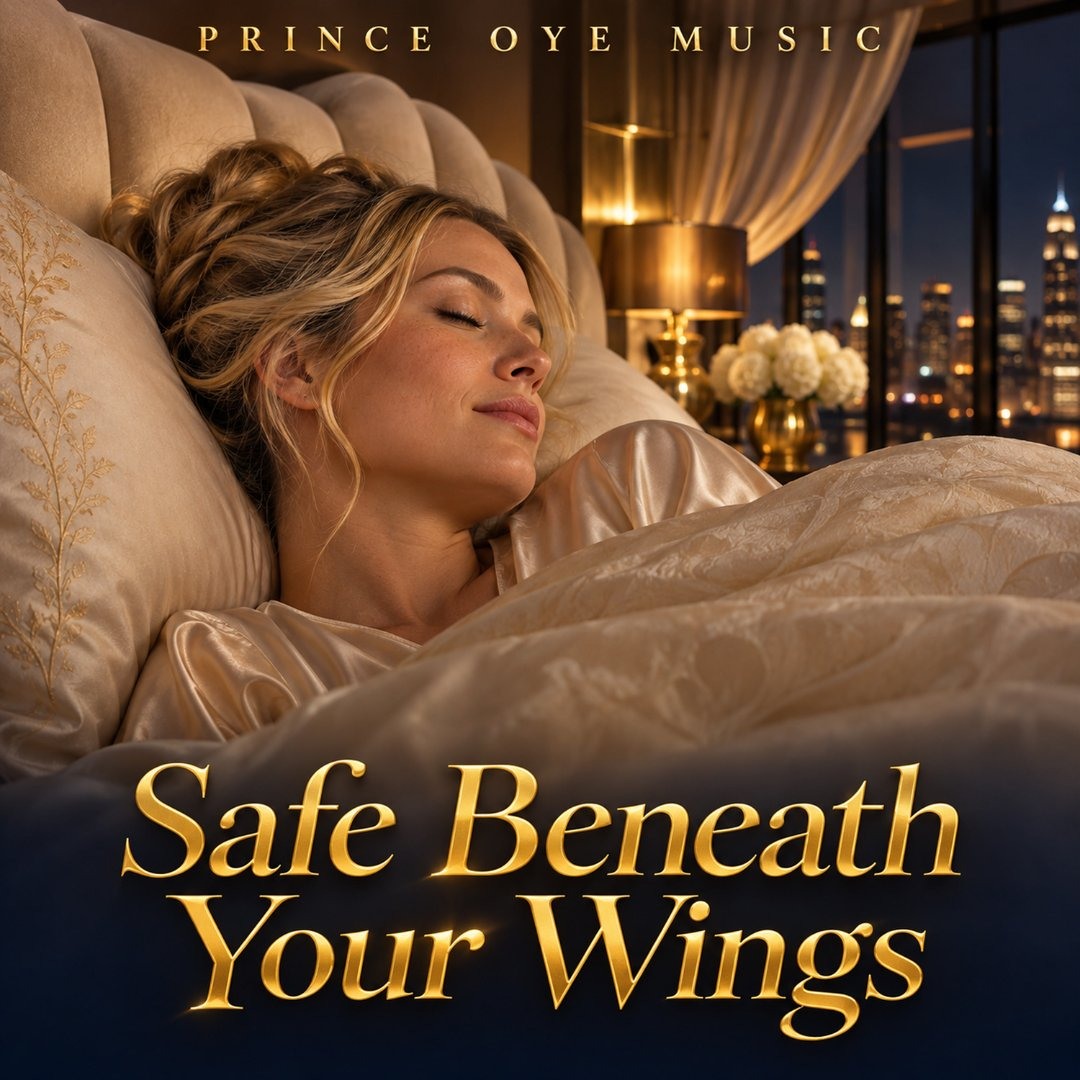
- Safe Beneath Your Wings is peaceful gospel worship from the Deep Sleep Worship Music collection, a song for quiet prayer, evening reflection and restful listening.
- In the Shelter of Your Wings is gospel worship for prayer, quiet time and rest, released on November 6, 2026.
- Under the Shadow of Your Love is peaceful gospel worship from the Sleep Music collection.
- Your Love Is My Refuge is gospel worship for prayer, quiet time and rest.
- Hidden In You is a gentle worship song about finding safety, rest and peace under God's covering.
- I Rest Beneath Your Care is gospel worship for prayer, quiet time and rest, from the Deep Sleep Worship Music collection.
For a long evening session to pray the psalm with, this peaceful session runs a little over two hours:
And this one runs a little over two hours as well:
If anxiety is part of why you are reading Psalm 91, see Worship Songs for Anxiety. For another psalm of rest, read the devotional How to Rest in God at Night: Psalm 4:8.
Frequently asked questions
What is the main message of Psalm 91?
That those who make God their dwelling place find shelter, safety and His company in every kind of trouble. It is a psalm of trust in the God who is Most High, Almighty, LORD and God.
What does "under his wings" mean?
It is a picture of God sheltering His people the way a mother bird covers her young. The same image appears in Ruth 2:12, Psalm 17:8, Psalm 36:7, Psalm 57:1 and Matthew 23:37.
What is the "secret place of the most High"?
It is the place of closeness to God, a hiding place and shelter in His presence. It is connected with the temple in the Old Testament and with prayer and abiding in Christ for believers today.
Does Psalm 91 promise that believers will never be harmed?
The psalm promises God's protection and presence, but the Bible also says believers will face trouble (John 16:33). Psalm 91:15 itself says God will be "with him in trouble." We hold both: God protects, and He accompanies us when we suffer. Psalm 91 does not replace wise decisions or medical care.
Why did the devil quote Psalm 91 to Jesus?
In Matthew 4 and Luke 4, the devil quoted verses 11 and 12 to tempt Jesus to jump from the temple. Jesus answered, "Thou shalt not tempt the Lord thy God." It shows that we must not use God's promises to justify reckless risks.
Who wrote Psalm 91?
The King James Version does not name an author in a heading for this psalm. It follows Psalm 90, which is headed "A Prayer of Moses the man of God," and some traditions have connected the two, but the text itself does not say, so we should not claim more.
A closing prayer
Most High, Almighty, LORD and my God, I come to dwell in Your secret place. You are my refuge and my fortress, and in You I will trust. Cover me with Your feathers, and under Your wings let me find rest. Take my fears one by one: the terror by night and the worry by day. Where trouble comes, be with me in it. Satisfy me with Your presence, and show me Your salvation. I rest under the shadow of Your wings tonight. Amen.
May you rest in His shelter. If you would like to keep worshipping, explore more videos from Prince Oye Music, or read Bible Verses for Strength and Peace of Mind.