Isaiah 26:3 Meaning: Perfect Peace for a Stayed Mind
By Prince Oye · November 28, 2026
"Thou wilt keep him in perfect peace, whose mind is stayed on thee." It is one of those verses people write on cards and tape to bathroom mirrors, and for good reason. When the mind will not sit still, when the headlines are loud, when a diagnosis or a deadline has taken up all the inside space, we want a peace that is more than a feeling we have to maintain.
This article is a slow reading of Isaiah 26:3. We will look at the song it sits in, the meaning of "perfect peace" and of a "stayed" mind, the reason the verse itself gives for the promise, and a simple way to practice it on an ordinary, restless day. At the end you will find worship songs from Prince Oye Music that were written for a mind that needs to be held.
All scripture is quoted from the King James Version (KJV).
The verse
"Thou wilt keep him in perfect peace, whose mind is stayed on thee: because he trusteth in thee."
— Isaiah 26:3 (KJV)
The very next verse belongs with it, because it tells us what to do:
"Trust ye in the LORD for ever: for in the LORD JEHOVAH is everlasting strength:"
— Isaiah 26:4 (KJV)
"Stay on thee" and "trust ye in the LORD for ever" are two ways of saying the same thing. The peace is promised to a person whose inner life is leaning on God, and the invitation is to keep doing that, not only for a moment, but "for ever."
Where the verse sits: a song in a hard time
Isaiah 26 is called, in the chapter itself, a song. It is sung "in the land of Judah," and it begins not with a calm feeling but with a city:
"In that day shall this song be sung in the land of Judah; We have a strong city; salvation will God appoint for walls and bulwarks. Open ye the gates, that the righteous nation which keepeth the truth may enter in."
— Isaiah 26:1–2 (KJV)
The setting matters. This is not a poem written from a quiet garden. Isaiah's world included threat, proud cities that would fall, and a people who needed a refuge that was not made of walls they had built themselves. "We have a strong city," the singers say, and then they immediately add that the walls and bulwarks are salvation, a gift of God. Verse 3 is the personal side of that same confidence. The God who guards a city can guard a mind.
If you have ever tried to find peace by arranging your circumstances first, this chapter quietly rearranges the order. Safety is not the condition of peace. God is.
What "perfect peace" means
The phrase "perfect peace" in the KJV translates a Hebrew doubling: shalom shalom. Hebrew often repeats a word to strengthen it, and shalom is already a large word. It means more than the absence of noise or conflict. It carries the sense of completeness, welfare, wholeness, things being as they should be.
So "perfect peace" is not a promise of a perfectly smooth day. It is a promise of a peace that is full: safety and well-being, inward and outward, the kind of completeness that comes from being kept. Many modern translations keep the idea with a phrase such as "perfect peace" or "peace, peace." The doubling is the point. It is peace in full, not peace in part.
The New Testament picks up the same fullness when it speaks of the peace of Christ:
"Peace I leave with you, my peace I give unto you: not as the world giveth, give I unto you. Let not your heart be troubled, neither let it be afraid."
— John 14:27 (KJV)
"Be careful for nothing; but in every thing by prayer and supplication with thanksgiving let your requests be made known unto God. And the peace of God, which passeth all understanding, shall keep your hearts and minds through Christ Jesus."
— Philippians 4:6–7 (KJV)
Paul's "peace of God, which passeth all understanding" is a close companion to Isaiah's "perfect peace." In both places, peace is something God does in the person who turns to Him, not something we have to produce by willpower. For a wider look at the Bible's language of peace, see Worship Songs About Peace for Restless Days.
What "stayed" means
This is the word that most modern readers trip over, because "stayed" in today's English usually means "remained." In 1611, "stay" could also mean to prop, support or lean, the way a stay or a staff holds something up. That older sense is closer to the Hebrew.
The phrase "whose mind is stayed" translates yetser samuk. Yetser can mean a formed thing, a frame, a disposition, the shape of a person's inner life. Samuk comes from a verb that means to lean, to prop, to support. The picture is not, first of all, of a person forcing every thought to stay on a single subject. It is the picture of a life that is leaning its weight on God, the way a person leans on a staff, or a building rests on its foundation.
The KJV adds "on thee" to make the object of that leaning clear. The verse then gives its own reason, and the reason is trust:
"because he trusteth in thee."
The Hebrew word behind "trusteth" is related to batach, to feel safe, to be confident, to rest secure. So the verse begins with a propped-up inner life and ends with trust, two pictures of the same posture. Psalm 112 uses a similar pairing of a heart that trusts and is not afraid:
"He shall not be afraid of evil tidings: his heart is fixed, trusting in the LORD. His heart is established, he shall not be afraid, until he see his desire upon his enemies."
— Psalm 112:7–8 (KJV)
This matters, because Isaiah 26:3 is sometimes taught as if peace were a wage we earn by concentrating very hard on God and never letting the mind wander. There is a right instinct in that teaching: a mind turned toward God is a mind in the right place. But the verse's own grammar will not let us make peace a prize for mental performance. The One who "will keep" is God. The verb has the sense of guarding or watching, like a watchman. We lean. He keeps.
If your thoughts are noisy, you are not disqualified. A stayed mind is not a mind that never has a worry. It is a mind that, when the worry comes, leans its weight back on the One who guards.
"Trust ye in the LORD for ever"
Verse 4 adds a name and a reason:
"Trust ye in the LORD for ever: for in the LORD JEHOVAH is everlasting strength:"
— Isaiah 26:4 (KJV)
"The LORD JEHOVAH" is an emphatic way of naming the God of Israel, and "everlasting strength" is, in the Hebrew, a rock of ages, a rock of eternity. The invitation is not "trust Him until you feel better." It is "trust Him for ever," because the strength you are leaning on does not wear out.
That is why this verse helps people in long seasons, not only in short panics. A stay is for holding something up over time.
How to stay a mind: a practical pattern
Isaiah 26:3 is a promise, and it is also an invitation to a practice. Here is a simple way to live in it, especially on a restless day. It takes about ten minutes.
1. Name what is leaning the wrong way. Write down the thought that is taking up the most space: a fear, a headline, a conversation, a what-if. Vague restlessness is hard to pray about. A named one is easier to hand over. 2. Read the verse slowly, twice. The first time, hear the promise: "Thou wilt keep him." The second time, hear the posture: "whose mind is stayed on thee." 3. Lean out loud. Say, "Lord, I am putting the weight of this on You. I cannot hold it up." If it helps, picture the staff, or the foundation, and then let the picture go. 4. Pray the companion verses. Philippians 4:6–7 gives the same movement: thanksgiving, request, and the promise of a guarded heart and mind. Psalm 16:8 says, "I have set the LORD always before me: because he is at my right hand, I shall not be moved." 5. Take the next ordinary step. Answer the message, take the walk, do the small piece of work. A stayed mind is not an empty mind. It is a mind that is held while it lives its day.
If racing thoughts are at their worst at night, add a short, screen-free wind-down and a verse such as Psalm 4:8. You may find help in Worship Songs for Anxiety and Christian Sleep Music With Scripture. If the restlessness is persistent, or if you cannot sleep or function, please also talk with a doctor. Trust in God and good care are not rivals.
"I have set the LORD always before me: because he is at my right hand, I shall not be moved."
— Psalm 16:8 (KJV)
"And let the peace of God rule in your hearts, to the which also ye are called in one body; and be ye thankful."
— Colossians 3:15 (KJV)
Colossians 3:15, "let the peace of God rule in your hearts," has the picture of an umpire making the call. When competing voices are loud, we invite His peace to decide.
Other scriptures that sit beside Isaiah 26:3
"Be still, and know that I am God: I will be exalted among the heathen, I will be exalted in the earth."
— Psalm 46:10 (KJV)
"And the work of righteousness shall be peace; and the effect of righteousness quietness and assurance for ever."
— Isaiah 32:17 (KJV)
"Great peace have they which love thy law: and nothing shall offend them."
— Psalm 119:165 (KJV)
"Now the Lord of peace himself give you peace always by all means. The Lord be with you all."
— 2 Thessalonians 3:16 (KJV)
And Jesus, honest as ever about the world we actually live in, says:
"These things I have spoken unto you, that in me ye might have peace. In the world ye shall have tribulation: but be of good cheer; I have overcome the world."
— John 16:33 (KJV)
Peace "in me," He says, not peace in a trouble-free life. Isaiah 26:3 belongs to that same honest hope.
Worship songs for a stayed mind from Prince Oye Music
These songs were written for people who need to be held steady. Descriptions follow the song pages and the video descriptions.
A declaration: "I'm not moved"
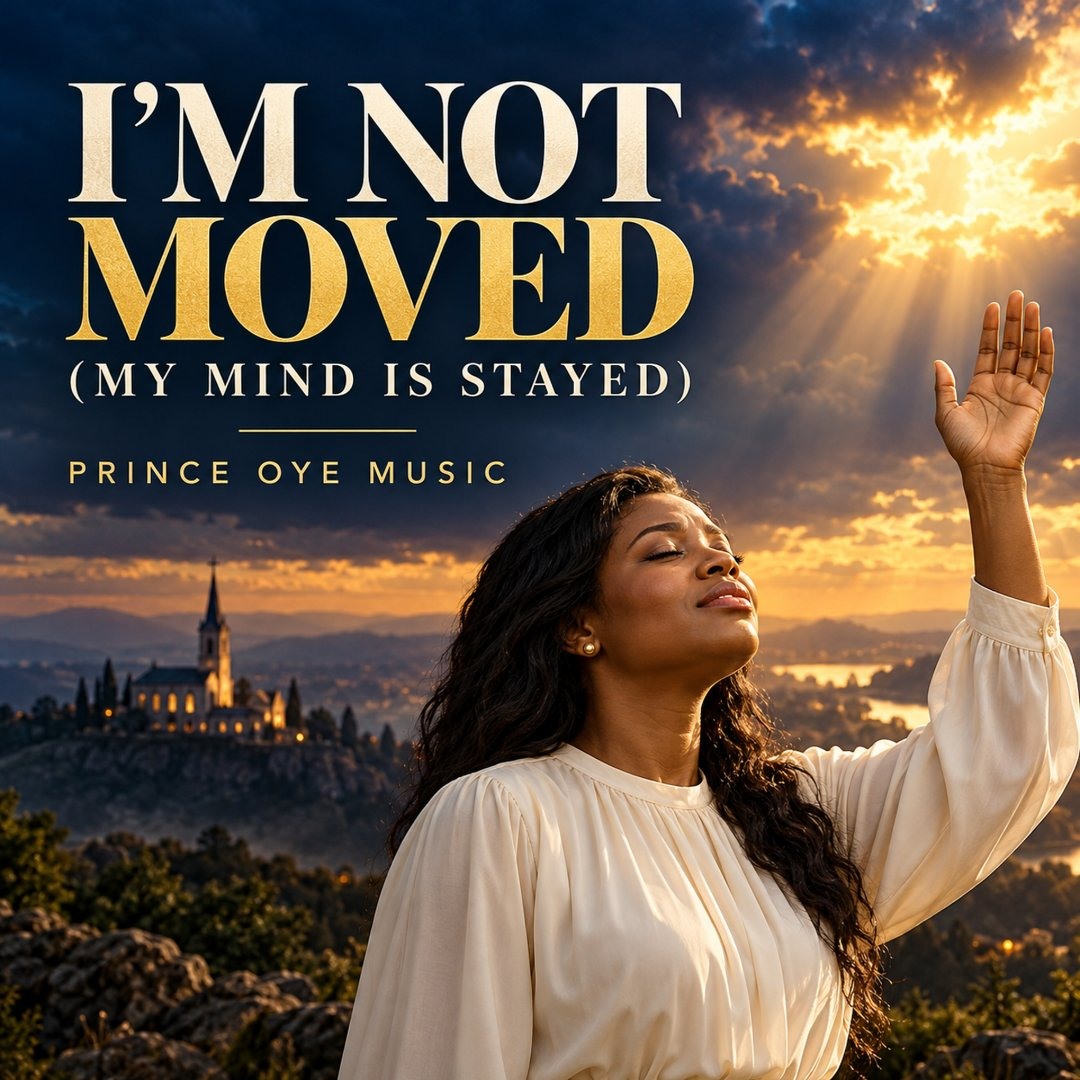
- I'm Not Moved (My Mind Is Stayed) is a gospel anthem from the Declaration Anthems series, released October 22, 2026. The song page puts the verse's language into a present-tense confession: the headlines get louder, the storms get stronger, but "my mind is stayed on Him." It names an economy that can shake, a diagnosis that can speak, a door that can close, and answers each one with "I'm not moved." The picture it uses, "like a tree planted by the water," sits in the same family as Psalm 1 and Jeremiah 17.
Songs of peace that hold
- Quiet the Storm Within is peaceful gospel worship from the Sleep Music collection, Vol. 1, for quiet prayer, evening reflection and restful listening.
- Perfect Peace While I Sleep is track 29 on Midnight Surrender: Soaking Worship Vol. 12, gospel worship for prayer, Bible meditation and quiet devotion. Its title takes the language of this verse into the night.
- You Are My Peace is gospel worship for prayer, stillness and quiet time with God, from the set Peace in Your Presence.
- Peace That Guards the Heart is track 11 on Midnight Surrender: Soaking Worship Vol. 12, a title that sits close to Philippians 4:7.
For a longer, quieter session, this one runs a little over two hours:
Frequently asked questions
What does Isaiah 26:3 mean?
It is a promise that God will guard, with a complete peace, the person whose inner life is leaning on Him. The reason the verse gives is trust: "because he trusteth in thee."
What is "perfect peace" in the Bible?
In this verse it translates the Hebrew shalom shalom, a doubled word for completeness and well-being, not only the absence of conflict. It is peace in full, kept by God.
What does it mean to have your mind "stayed" on God?
In the language of the KJV, "stayed" has the sense of being propped or supported. The Hebrew picture is of a disposition that leans its weight on God, not of a mind that never wanders. When the mind does wander, the practice is to lean again.
How can I apply Isaiah 26:3 when I am anxious?
Name the worry, read the verse, tell God you are putting the weight of it on Him, and pray. Combine that with the ordinary helps God also gives: rest, wise counsel, and medical care when it is needed. Peace is His keeping, not a test you have to pass.
What is a good song for meditating on Isaiah 26:3?
"I'm Not Moved (My Mind Is Stayed)" by Prince Oye Music takes the verse's language and turns it into a confession for a shaking day. Quieter options include "Perfect Peace While I Sleep" and the Peace in Your Presence collection.
A closing prayer
Lord, You have promised to keep the one whose mind is stayed on You. We confess that our thoughts run, and that we have tried to hold ourselves up. Today we lean our weight on You. Be our everlasting strength, our rock, and the guard of our hearts and minds. Give us the perfect peace that does not come from a quieter world, but from You. We trust You, and we will trust You still. Amen.
The Lord of peace give you peace always. If you would like to keep worshipping, explore more videos from Prince Oye Music.